How to Measure AI ROI in Food and Beverage: Start With One Pilot
In Germany 57% of companies with 20 or more employees use AI, yet only 45% of those users see a measurable contribution to business success. To measure AI ROI, run one pilot: log a baseline first, pick 1 to 3 KPIs and set the threshold for scale before the start. After about 6 weeks the numbers tell you in euros whether to scale, redesign or stop.
Key takeaways
- Measure two weeks of baseline before the pilot starts.
- Set the threshold for scale before the start, so the result decides.
- Decide by the numbers: scale, redesign or stop.
Most companies use AI. Fewer than half can show what it brings.
The "most" refers to Bitkom's survey of 603 companies in Germany with 20 or more employees, run in July and August 2026. 57% of them use AI, up from 36% a year earlier. Of the users, 45% see a measurable contribution to business success and 3% say they use AI's potential rather strongly. As Bitkom's president put it, the real work starts now.
IBM asked 2,000 CEOs worldwide in 2025: 25% of their AI initiatives had delivered the expected ROI, and 16% had scaled across the company.
Where food and beverage companies stand
The food sector started later and is now growing fast. In Germany 15.1% of food, beverage and tobacco manufacturers used AI in 2025, up from 9.25% in 2024. Across all sectors Eurostat covers it was 25.97%. These official figures from Eurostat count companies with 10 or more employees that use at least one of a set list of AI technologies, so they do not form one trend line with Bitkom's 57%.
AI rarely reaches the plant. In 2025, 2.34% of German food manufacturers used AI in production processes, against 6.05% in marketing or sales.
At the same time the pressure on every working hour is high:
- Earnings: In September 2025, 42 of 100 surveyed food manufacturers rated their earnings as worse.
- Staff: In December 2025 a vacancy took 231 days on average to fill.
- Administration: In 2025, 31% of the industry's workforce worked in administration and management.
- Structure: 90% of the industry are small and mid-sized businesses.
In our view the administration share is where a first pilot is easiest to measure, and the worked example below sits there.
Why AI pilots stall before they scale
BCG and The Consumer Goods Forum surveyed 39 senior consumer goods and retail executives in 2026. Roughly 75% of the consumer goods respondents were still piloting or exploring, and 18% were scaling impact. Across both sectors, more than half did not formally measure AI ROI.
BCG names the gap: many pilots track data without a clear baseline or a threshold for scale. The barrier cited most often: pilot economics did not carry over to full-scale results.
How to measure AI ROI in five steps
1. Start with the bottleneck, not the tool
Pick the process where time or errors hurt most. Before you decide, talk to the people who do the work, because in our view management and operations often see different bottlenecks. Then ask whether AI can help.
Among German companies that do not use AI, 30% see no use cases. Use cases are easier to see from work that costs hours every week.
Our article on AI audits for food and beverage shows how to find that work: interviews, an Ops Canvas and an Opportunity Matrix. Its Money Slide gives an estimate of the ROI. The pilot turns that estimate into a measured number.
The principle behind it: look at your processes first, find a quick win, test it in a small pilot and only scale what works.
2. Measure the baseline for two weeks
Log how the process runs today before the pilot starts. We recommend two weeks, enough for a normal mix of work. Record the minutes per case, the number of cases and how often an answer needs a second round. A shared sheet will do.
For 93% of AI-using companies in Germany, data preparation is a cost item. So the log is also a first look at your data.
3. Choose 1 to 3 KPIs and one guardrail
One main KPI carries the decision, such as handling minutes per case. One guardrail must not get worse, such as rework. BCG advises measuring AI as you would any P&L item.
A study of 5,179 customer support agents measured productivity with one clear figure, with and without an AI assistant: issues resolved per hour. It rose by 14% on average. Your pilot needs the same: one clear figure, measured before and during the pilot.
4. Set the threshold for scale before you start
Write down the number that means "scale" before day one, and include the running costs at full volume. A threshold set afterwards bends to the result. A threshold set before decides it.
5. Decide: scale, redesign or stop
The numbers give one of three answers:
1. Scale: the threshold is met. Roll out to the next team.
2. Redesign: the gain is real but too small. Change the scope or the source documents and test again.
3. Stop: the numbers do not move. End it and keep what you learned.
Stopping is common. S&P Global Market Intelligence found that the average organization scrapped 46% of its AI proofs of concept before production. What matters is whether you stop after 6 weeks with a number or after a year with a feeling.
Metadine's own process has the same order: analysis, prototype, development.
Worked example: a 6-week pilot for spec and certificate requests
In inside sales at an ingredient supplier, most of the day can go into the same incoming questions: specs, certifications and application fit. A pilot on that work could look like this. Every number is an assumption.
Assume a mid-sized food manufacturer whose inside sales team answers 150 requests a week.
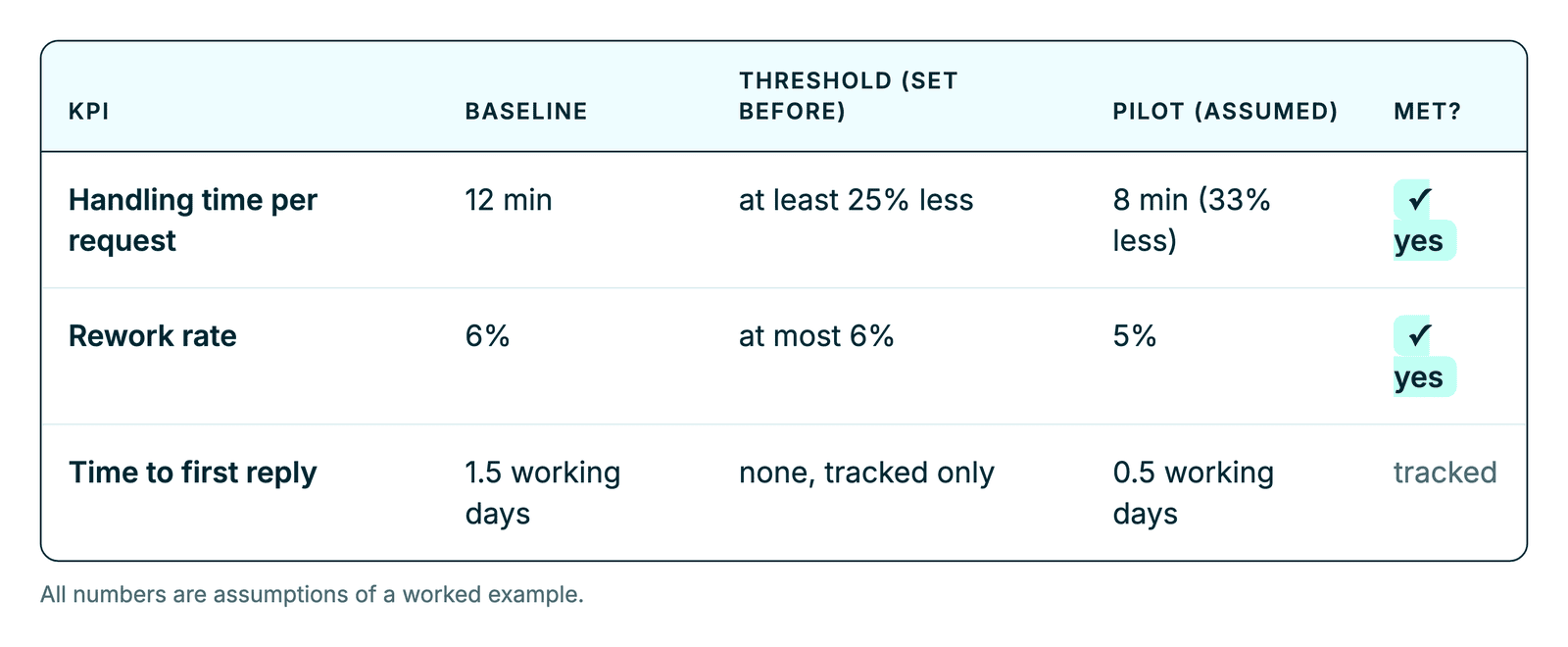
1. Baseline (2 weeks): 12 minutes per request, so 150 × 12 = 1,800 minutes or 30 hours a week. Rework is 6% and the first reply takes 1.5 working days.
2. Pilot (6 weeks, one product group): the AI drafts each reply from approved spec sheets and certificates. A person checks and sends every draft. Main KPI: handling minutes. Guardrail: rework rate.
3. Threshold (set before the start): at least 25% less handling time, rework at or below 6% and a yearly value above the running costs.
4. Result (assumed): 8 minutes per request, including the human check of every draft. That saves 4 × 150 = 600 minutes, or 10 hours a week. Rework falls to 5% and the first reply takes 0.5 days.
The scorecard compares the assumed pilot with the baseline and the threshold.
In euros: 10 hours × 46 working weeks = 460 hours a year. At an assumed labor cost of €35 an hour, 460 × 35 = €16,100. Licenses and upkeep cost an assumed €300 a month, or €3,600 a year. That leaves €12,500 a year before one-off setup costs. The threshold is met: scale to the next product group.
10 hours a week is a quarter of an assumed 40-hour position, in a sector where a vacancy took 231 days to fill.
Counter-case. Assume the pilot reaches 11 minutes instead of 8, only 8% less. The saving is 2.5 hours a week, worth €4,025 a year. After running costs €425 remain. Below the threshold: redesign or stop. Either way you know after 6 weeks.
FAQ
How long should an AI pilot run?
The worked example runs 6 weeks after a 2-week baseline. We suggest 4 to 8 weeks in general, long enough for the normal mix of work. In our view a shorter pilot may miss the rare, slow requests and end up measuring mostly the easy ones. Fix the end date before the start.
What if we have no data for a baseline?
Then the baseline is your first data. Log the work by hand for two weeks in a shared sheet: start, end, type of request and whether it needed a second round. That is enough to set a threshold, and it shows early where your records need cleaning.
Do we need AI training before the pilot?
A short briefing helps, because the pilot team checks every AI draft. Article 4 of the AI Act says that providers and deployers "shall take measures to support the development of AI literacy of their staff". Bitkom found that 70% of the companies it surveyed already train their employees in using AI.
What does a first prototype cost?
At Metadine we offer this first step at an affordable, three-digit price. With a prototype, we test hypotheses in a measurable way before a larger-scale solution is considered. In our view the larger costs come later, with the rollout. For AI-using companies in Germany infrastructure, data preparation and integration are the most frequent large cost items.
Conclusion
You can measure AI ROI without a big program. Pick one bottleneck, log two weeks of baseline and set the threshold before you start. Then the numbers decide: scale, redesign or stop.
Start small, measure and scale only what works. The first call is free and takes 45 minutes. Which process would you measure first? Book a discovery call.
Sources
1. Erstmals nutzt die Mehrheit der Unternehmen KI. Bitkom, press release, 14 September 2026.
2. KI in der deutschen Wirtschaft. Bitkom Research, presentation, 14 September 2026.
3. Artificial intelligence by NACE Rev.2 activity (isoc_eb_ain2). Eurostat, dataset, updated 15 June 2026.
4. Statistikbroschüre 2026. BVE, 2026.
5. Konjunkturbericht der Ernährungsindustrie 02/2025. BVE, 2026.
6. CPG and Retail Leaders Are Bullish on AI, yet Most Haven't Scaled It Where It Matters Most. BCG and The Consumer Goods Forum, press release, 24 June 2026.
7. AI in CPG and Retail: How Winners Are Pulling Ahead. BCG, 24 June 2026.
8. IBM Study: CEOs Double Down on AI While Navigating Enterprise Hurdles. IBM, press release, 6 May 2025.
9. AI project failure rates are on the rise: report. CIO Dive, reporting S&P Global Market Intelligence, 14 March 2025.
10. Generative AI at Work. Brynjolfsson, Li and Raymond, NBER Working Paper 31161, 2023.
11. Article 4: AI literacy. European Commission, AI Act Service Desk, consolidated text as of 27 July 2026.